Andy Grove Its Not About What You Know
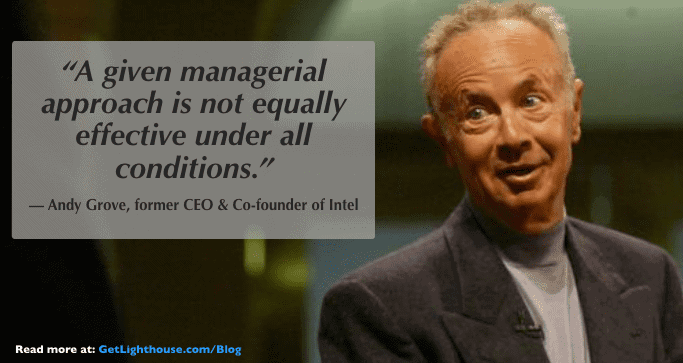
Andy Grove, pictured below, is one of the greatest CEOs ever. He co-founded Intel and grew it to over $20 Billion in revenue over a 30 year run equally CEO. His approaches to leadership and management are legendary.
He shared many of his ideas in a serial of books, including the direction guide, High Output Management. I highly recommend the volume for any manager, as do others:
I read this book presently subsequently that recommendation, and my but regret was non reading it sooner. Information technology really is the best book for new managers to starting time with, and fifty-fifty veteran managers can learn a matter or two from it.
Today, nosotros share some of my favorite lessons from the volume, so hopefully yous'll be convinced to pick up a copy to read for you or a fellow manager.
Table of Contents:
- You can be a great managing director regardless of your state of affairs.
- Fix Problems when they're small.
- Measure what's important and ready a standard.
- Time is your scarcest resource as a manager.
- Leading past example trumps everything else.
- Consul what you lot know best.
- Regular one-on-ones are a loftier-value investment.
- When your team member shares something of import, write it downward!
- Your team oft has more perspective than you.
- Simply you can salvage your squad member from quitting.
- Ask 1 more question.
- Guide your people with regular coaching.
- Bonus

12 Andy Grove Quotes from High Output Management
The post-obit Andy Grove quotes are my favorites from the volume, which has a lot of depth and ideas well worth learning for any manager.
Use these invaluable pieces of wisdom to become both a better leader and managing director:
1) You tin can be a swell manager regardless of your situation.
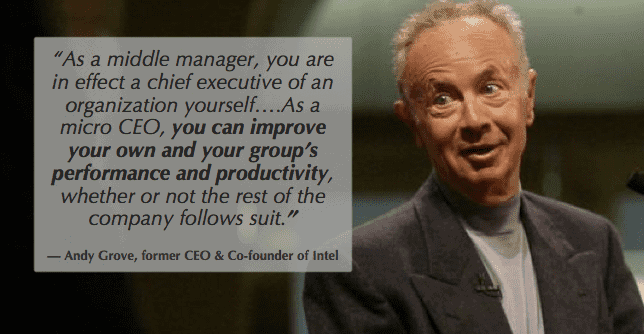
"As a heart manager, yous are in consequence a main executive of an organization yourself… As a micro CEO, you can improve your own and your group'southward performance and productivity, whether or not the rest of the visitor follows suit."
Be great no matter what'south happening in the rest of your company. Don't apply the failings of those effectually you every bit an excuse; great management will make your team follow you lot anywhere you lot go.
Especially in larger organizations, you may non be able to change or set up everything, but you can do a lot to aid shield your squad and make their lives better.
If you produce solid results (and proficient management will help you do so), in most cases your company will requite you leeway to continue what you're doing, even if it's not standard in the company. Don't wait for permission to exist a practiced manager for your team; accept the initiative yourself. Your team will thank you lot.
Further Reading: Learn how to help your team fifty-fifty in a tough company environment here.
ii) Fix Problems when they're pocket-size.
"A common rule nosotros should always try to mind is to find and gear up any trouble at the lowest-value stage possible."
Information technology bears repeating: Gear up bug when they're pocket-size! Equally a manager, you have plenty of tools to detect them if you but listen to your team.
Don't wait until you have a major crisis on your hands. Past then, it will take a ton of your time to address and it risks putting you lot into a reactive management manner that is hard to break out of.
This is where 1-on-ones can help (more on this afterward) likewise as surveys and open up advice with your team. The cardinal is to exist sure you're asking the correct questions, and following through on what y'all hear. If you don't ask, you won't know, and if you don't follow through, your team volition stop telling yous about things y'all need to know.
Further Reading: Stuck fire-fighting besides oftentimes? Larn how to break the vicious bike of reactive management here. Then, work on your listening skills hither to hear issues sooner.
3) Measure out what'south of import and gear up a standard.
"Measurement against a standard makes you retrieve through WHY the results were what they were."
You manage what you measure. The act of planning and then creating a way to measure the result: a number, a deadline, etc will have many benefits across just the assigned task.
Measurement also makes you call back in ways you may not always think if yous're rushing around all the fourth dimension. It sets the expectations for your people on what they must practice and how their work volition be evaluated.
As Dale Carnegie recommends, "Give the other person a fine reputation to live upwardly to", and with the correct mensurate, y'all might just be surprised the results you will get.
Further Reading: Accountability and measurement starts with managers. Acquire how Google measures their managers hither, and get your ain Director Score here.
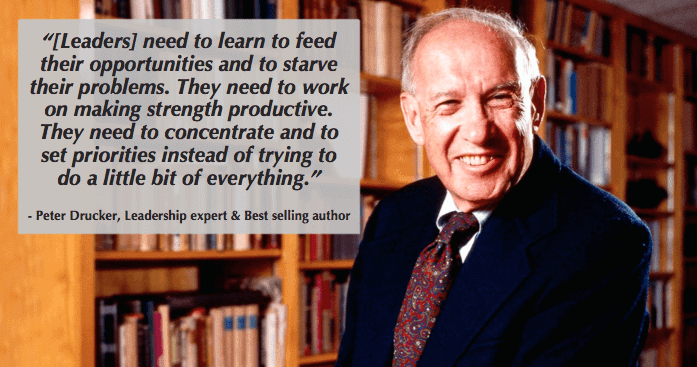
4) Time is your scarcest resource as a director.
"The single most important resource that nosotros allocate from one 24-hour interval to the next is our own time."
Managers must ruthlessly manage their time. Consider information technology an investment (Grove, even in writing the book in 1983, valued a manager's time at $100/60 minutes). Avert being in constant, reactive management and focus on priority management not time management.
Every bit Grove puts it, 'When you say "yes" to one thing, you are inevitably maxim "no" to another."
You lot can find yourself in meetings all solar day every day if you're not careful, but that'due south no fashion to be effective. It too keeps y'all from many other important activities and long term thinking.
Budget your fourth dimension and invest in yourself by blocking off time for big-picture thinking. Don't shortchange the investment in your people either, so also brand sure you make time for regular time for one-on-ones.
Further Reading: Need to find more hours in the 24-hour interval? Acquire how to ameliorate upkeep your time via priority management here.

5) Leading by example trumps everything else.
"Values and behavioral norms are only not transmitted easily past talk or memo, but are conveyed very effective by doing and doing visibly."
Lead by example. What you do is what your team will emulate and believe is expected and valued.
Ask yourself: What is your team emulating from you…both good and bad? Grove believes, "The responsibleness for transmitting mutual values rests squarely with the supervisor."
In Ben Horowitz's book, The Hard Thing Nigh Hard Things, ane of the stories he recalls is that his swearing was picked up by the rest of his team. It ended upwards becoming a big issue and he had to explain to the whole visitor exactly the kind of swearing that would and would non be acceptable at the company and set his ain example to follow it.
Fifty-fifty simple things are noted by your team.
This is peculiarly true and important when considering promotions. When yous promote someone, it signals to the residuum of the arrangement what is valued about (promotions are a huge reward with many benefits afterwards all).
Someone who lives a value and is promoted will set an case for others, while someone who is not a good example, but was promoted anyhow, says that behavior is not just tolerated, but rewarded.
Farther Reading: Exercise you promote from within at your visitor? Hither are 10 common pitfalls to avoid when promoting from within and more on developing leaders when your squad gets too big, and so yous set the correct example.
6) Delegate what yous know best.
"Considering it is easier to monitor something with which you lot are familiar, if you lot have a choice you should consul those activities you know best."
This may seem counter-intuitive. Information technology was to me when I start read it, but Grove'due south case makes a lot of sense.
If y'all're familiar with a task, it's easier to tell if someone else is well-qualified to take information technology on. Also, once they're doing the job, you lot'll need less oversight to tell if things are going well or not. This helps everyone win, as you're less probable to make a hiring mistake, and won't exist as likely to need to micro-manage.
At present, don't confuse delegation with abdication; you still need to monitor work to maintain quality and to make your team experience connected and appreciated. The best way to do that is to look at rough drafts, and then yous catch problems while they tin still exist privately fixed as well every bit give specific feedback that will shape the upshot you desire.
Further Reading: Learn more nearly how Andy Grove decides how hands-on to be with someone via his concept Task Relevant Maturity here.
7) Regular 1-on-ones are a high-value investment.
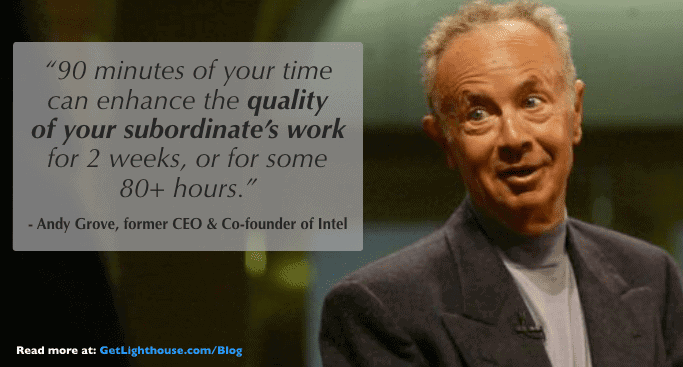
"90 minutes of your time tin enhance the quality of your subordinate'due south work for two weeks, or for some 80-plus hours."
One-on-ones matter. A lot. Ben Horowitz was willing to burn over someone not having 1-on-ones. If yous're non having them, get started now and if you lot're canceling i-on-ones a lot now, get committed.
This is a meeting that's an investment in your team. They're humans, not robots. Your time and attention is valuable to them and will pay major dividends to both of you.
You volition have different situations to always handle and gear up, and as we discussed in #two, you want to catch problems when they're small. That's where ane-on-ones come in considering they're lower pressure than coming to your office or interrupting y'all, no thing how open your admissible policy is.
Call back, one-on-ones are almost them equally Grove writes, "the well-nigh important benchmark governing matters to be talked about is that they be issues that preoccupy and nag the subordinate."
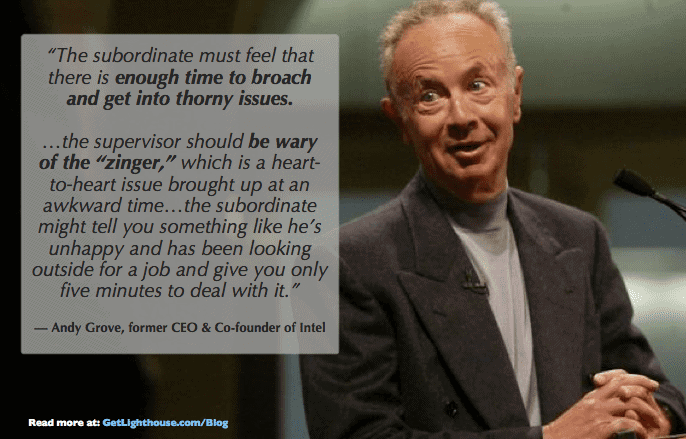
Having these discussions every calendar week or two ensures no problem goes as well long without being addressed.
Want to accept awesome one on ones like Andy Grove? Then sign upward for a gratuitous trial of Lighthouse, because information technology's based on many of the principles in High Output Management.
eight) When your team fellow member shares something important, write it downwards!
"Equally important is what "writing information technology down" symbolizes...the act implies a commitment, like a handshake, that something volition exist done. The supervisor, also having taken notes, can then follow up at the next one-on-ane."
Don't take notes in your 1-on-ones? You should. They WANT you to.
If a team member takes the time to bring information technology upwardly, it matters to them. They want you to take action, not just talk about it. So accept your notes and set some action items by the end of your one-on-ones and other critical meetings.
With how busy the average managing director is, information technology'southward a mistake to presume yous'll call back something after.
Fifty-fifty if y'all can recollect, y'all're stressing your encephalon to juggling that and the many other items competing for your attention each twenty-four hours. It shouldn't be surprising that things are easily forgotten when that is the example. Sadly, when you forget, your team member tin become discourage, because they remember that means yous don't care or information technology'due south not that of import.
Fortunately, an app like Lighthouse can help you stay organized all in one place and manage those action items for you and your squad member automatically for those crucial one-on-one discussions.
Further Reading: Desire some tips on how to have notes in a diverseness of environments? Here are our best tips for always taking expert notes, and if you demand more convincing, here's why you should always accept notes as a manager.
9) Your team often has more perspective than you.
"We managers get a footling more obsolete every solar day."
As you rise in the ranks and spend more time managing, you get asunder from the experiences you have as an individual correspondent. Be careful to not lose touch. Trust your people to help you lot stay grounded.
This is why the Toyota Total Product System is focused on getting insights from the front end lines. There they railroad train their managers to get feedback and insights directly from people on the assembly line.
Tap your team for insights when you can and reward candor. Yous demand the harsh truth earlier you get blindsided.
This is why Grove challenges managers to Ask: "What exercise I have to do today to solve — or better, avert — tomorrow'southward trouble?"
If you're ever thinking about that, you'll probable enquire the right questions of your squad to find out.
Further Reading: Do you take managers reporting to you? If so, consider asking these questions in manager i on ones, and employ skip level one on ones from time to time to get more direct feedback from the front end lines of your company.
10) Only you tin relieve your team fellow member from quitting.
"In almost all cases, the employee is quitting because he feels he is not important... If you do non deal with the situation right at the first mention, you'll confirm his feelings and the consequence is inevitable."
If y'all're at chance to lose someone from your team, you must act immediately. A lot has to happen for someone to want to interview and change jobs and so the condition quo will not keep them.
Grove outlines five primal steps to save a lost employee:
- Drop what you're doing. Sit down and ask why they're quitting.
- Mind to everything they have to say, and inquire questions to clarify.
- Don't endeavor to change their listen at that moment. Instead, await for opportunities to change things in the ways they want.
- Y'all MUST follow through on whatever you lot commit to doing. Y'all become the Project Manager of the solution to keeping them.
- Even if yous will lose them to another department, you owe it to the visitor to go on them in the visitor. Karma will pay you back someday.
A story: A Frustrated Friend
A friend of mine experienced this first-hand. Once he got extremely frustrated at work. He was out of the loop on a few things, his chore was super-demanding at the time, and some of his favorite coworkers who were early employees left.
1 mean solar day, he was totally fed up and he stormed out of the office to get some fresh air. An hour afterward he returned calmer merely even so thinking virtually quitting.
During that hour, a close coworker interrupted 1 of the leaders in the organisation to tell them they feared they were nearly to lose one of their all-time teammates. The leader immediately took action.
He canceled his meetings and went to go coffee with my friend. He listened intently and helped alleviate my friend'due south concerns over the next few days.
Because they acted so speedily and effectively, three and a half years later, my friend is nevertheless at the company.
Don't take your best people for granted.
As Grove writes, "Concentrating on the stars is a high-leverage activity: if they get amend, the impact on group output is very great indeed."
This is why fifty-fifty when things are going great y'all should exist having one-on-ones; your good people want to abound and exist challenged. They also likely have great insights into the front end lines discussed in #9.
Farther Reading: Demand to plough around morale issues? Hither are a few places to start:
- Hither's how you may be contributing to depression morale every bit their manager.
- If it's actually bad, here's how to absolve for being a poor manager that's losing people left and right.
- If your company is losing employees in waves throughout the company, hither's what to practise.
11) Inquire 1 more question.
"When the supervisor thinks the subordinate has said all he wants to about a discipline, he should inquire another question. He should try to keep the flow of thoughts coming by prompting the subordinate with queries until both experience satisfied they have gotten to the bottom of the problem."
Curiosity is a mindset that every manager needs to develop. That's because asking the right questions tin can make all the departure.
Request the right question tin can help you:
- Learn almost your team members and then you can lead them better
- Build rapport and trust
- Reveal bug that they don't bring up on their own
- Larn feedback that tin assist you be a better manager to your entire team
- Uncover their goals and dreams then you can put them on a path toward professional evolution
- And a lot more than.
The right question asked at the right fourth dimension can mean the difference between success– uncovering an issue that's growing within the team early on– and failure– never realizing there's an issue until a third of your team walks out the door.
Problems won't knock on your door, y'all have to go in search of them. You do that by request good questions, especially during i-on-ones where your people are more than willing to open up.
Questions are especially proficient for earthworks around without having to make assumptions or rushing to judgment.
You tin ask what someone thinks virtually how the team is functioning if y'all sense an issue between squad members or about their goals. Meanwhile, if you lot want to know more about their motivations, let them speak, and heed attentively.
By request good questions, what you learn becomes invaluable as it helps you lead anybody meliorate moving forward.
Further reading: We have a collection of questions you can ask as a manager for every situation. Try these in your 1 on 1s:
- One on One Coming together Questions Nifty Managers Inquire Their Teams
- 18 Questions to Inquire Your Manager to Improve Your Relationship and Better Manage Up
- 31 Questions to Ask Remote Employees to Better Support Them
- 6 Questions You Must Ask When You Start Managing a New Team
- 51 Questions to Inquire in One on Ones with a Manager
- 47 Questions to Ask in Your Skip Level 1 on ane Meetings
12) Guide your people with regular coaching.
"The responsibility for didactics the subordinate must be assumed by his supervisor, and not paid for past the customers of his arrangement, internal or external."
Request a team member to practice something they oasis't done before tin can be a bully learning experience for them and valuable for the team as a whole. Merely brand sure you're not making your customers pay for their tuition in the process.
As Grove writes, allowing your people to make their own mistakes unguided can have unwanted repercussions:
"'He has to make his own mistakes. That'southward how he learns!'
The problem with this is that the subordinate's tuition is paid by his customers. And that is absolutely wrong.
The responsibility for teaching the subordinate must be causeless by his supervisor, and non paid for past the customers of his organization, internal or external."
Instead of throwing your people into a new task and letting them larn solely from experience, gauge where each person is at and charabanc them based on their task-relevant maturity.
Equally their skills develop, go along to guide them with regular coaching during your one-on-ones. Place the right areas to work on with each person and the right feedback to requite them to assist them move forward.
Farther reading: If you want to learn more than about why managers need to become coaches and how to get a great coach to your team, read Why Today's Managers must Become Coaches (and how yous tin can exercise it).
Bonus: Management is not ane-size, fits-all:
"Don't confuse people's Job-Relevant Maturity with their general competence."
Just considering someone was swell at ane task does non mean they're well-prepared for some other. Equally a manager, you must recognize that you need to arrange to the skills, personalities, and needs of your squad. You lot cannot manage in a ane-size, fits-all approach.
When it comes to skill sets, Grove recommends treatment management through his concept of Task Relevant Maturity:
- When someone's skills for a chore are LOW, requite structured, task-oriented instructions. Tell them when, what, and how.
- When someone'southward skills for a job are MEDIUM, requite accent to two-style communication, back up, mutual reasoning. Focus on the private and any needs they accept.
- When someone'southward skills for a task are Loftier, exist hands-off. Establish objectives and monitor every bit needed.
You tin learn more about Chore Relevant Maturity with your squad here, and for your own Task Relevant Maturity, read our post hither.
Management is a series of never-ending challenges. Being able to arrange, sympathise, and heed well are critical skills. Grove covers a lot of basis in his book and these are simply a few of the crawly quotes from the book. I highly recommend you lot pick up your own copy of High Output Management.
What are your favorite Andy Grove quotes?
Did nosotros mention your favorite Andy Grove quotes from High Output Management? Let us know in the comments below.
And want to have awesome 1 on 1s like Andy Grove? So sign up for a free trial of Lighthouse, because it's based on many of the principles in High Output Direction.
Source: https://getlighthouse.com/blog/andy-grove-quotes-leadership-high-output-management/
0 Response to "Andy Grove Its Not About What You Know"
Post a Comment